




Dominique Garcia Marschall
Marketing and Communication Manager


18 March 2026
Share




Picture this: a mid-size component supplier receives a message from their largest customer. They require verified Product Carbon Footprint (PCF) data for every part they deliver – standardised and machine-readable. No process, no system, no methodology is in place. But a contract is at stake.
This scenario is no longer hypothetical. Several EU climate regulations – read on for details – are systematically demanding verified emissions data along manufacturing supply chains.
The infrastructure built to handle exactly that demand is the industrial data space, a digital infrastructure that allows companies to exchange data with defined partners – without losing control of it. Unlike a central platform owned by a single vendor, a data space is decentralised: each participant connects via a standardised interface, defines their own access rules and retains full sovereignty over what they share, with whom and for how long.
Many owners of small and medium enterprises (SME) still think of data spaces as abstract infrastructure for large corporations with dedicated IT departments. That assumption is dangerously out of date. The regulatory clock is ticking. Companies that act now will not only be able to meet compliance demands, but they will also unlock entirely new revenue streams in the process.

The regulation creates the demand. Data spaces are built to meet it – and offer many more chances!
Three EU regulations are reshaping the data obligations of manufacturing supply chains simultaneously. They differ in scope and mechanism, but share a common consequence: verified emissions data must flow reliably between companies – and the burden of producing it falls increasingly on suppliers.
As of 1 January 2026, the EU’s Carbon Border Adjustment Mechanism (CBAM) has become effective. Importers of steel, aluminium, cement, fertilisers and related goods must now purchase carbon certificates priced at the EU Emissions Trading System (ETS) auction rate – currently around €65 to 70 per tonne of CO₂. Default emissions estimates are no longer accepted; actual, installation-level production data is mandatory.
For manufacturing SMEs, the impact is indirect but severe. If companies process imported materials or are part of a supply chain that touches CBAM-covered goods, their customers need verified emissions data to calculate what they owe under CBAM. Without it, they must fall back on conservative default emission values – which tend to overstate actual figures, meaning they overpay for certificates – or risk penalties from customs authorities for under-reporting. SMEs who cannot deliver verified data risk being replaced by those who can.
The Corporate Sustainability Reporting Directive (CSRD) requires thousands of large EU companies to disclose standardised, audited scope 1, 2 and 3 emissions data. Scope 3 – indirect supply chain emissions – typically represents 70–90% of a large manufacturer’s total footprint. The only way to report it is to collect it from suppliers.
The CSRD reporting threshold refers to companies with more than 1,000 employees and either revenue exceeding €50 million or a balance sheet total over €25 million – they are obliged to report. But even SMEs well below this are receiving detailed supplier questionnaires from their original equipment manufacturer (OEM) customers. And although the “Stop-the-Clock” directive has delayed wave 2 and wave 3 reporters, the direction stays unambiguous. Dozens of customers, each with different templates and methodologies, demanding the same underlying data in incompatible formats – manually, via email and spreadsheets. It is simply not sustainable.
From 2026 onwards, the EU’s Ecodesign for Sustainable Products Regulation (ESPR) will require Digital Product Passports (DPP) for a growing range of goods, with lifecycle CO₂ data as a mandatory field. SMEs in machinery, electronics and textiles will need to produce standardised, machine-readable product data.
Measuring the carbon footprint credibly requires primary data from multiple supply chain tiers: energy consumption, raw material origins, transport distances and waste outputs. Today, this data is scattered across management systems, spreadsheets, machine logs and email inboxes. Without a shared data infrastructure, every SME builds its own collection silo – multiplying cost, producing unverifiable results and starting from scratch for every new customer request.
How can this be prevented?
In a data space, organisations can exchange data with selected partners without handing over their data. They define the conditions under which their data can be accessed or used. As a result, they always retain sovereignty over their data. The two membership-based associations International Data Spaces Association (IDSA) and Gaia-X provide the technical standards and governance frameworks.
Three principles underpin every data space:
Crucially, data never leaves the provider’s infrastructure without explicit, policy-governed authorisation.
Manufacturing SMEs generate enormous volumes of process, quality and performance data every day – trapped in machines. In a data space, this data can become a product. As a data provider, a company can monetise assets it already owns at marginal additional cost, while data consumers gain efficiency through better material selection, process optimisation and benchmarking.

The asset is already installed. It just hasn’t been connected to a revenue model yet.
From IIoT spindle to data product. Nuremberg-based spindle manufacturer GMN Paul Müller Industrie GmbH & Co. KG integrated sensor modules directly into its IDEA 4S grinding and milling spindle series. Each spindle records bearing temperature, vibration, rotational speed and clamping state in real time – data that until now remained local to the customer’s machine.
The challenge: how to make that operational data useful beyond the individual installation. Connected to a data space, the spindle becomes a data provider. Under usage policies defined by GMN, anonymised load and wear profiles can be shared with maintenance service providers or tooling partners – enabling condition-based service scheduling without exposing individual customer data. The data already exists. The data space provides the governed channel to turn it into a service.
With IDEA-4S, our spindles have always generated rich operational data – temperatures, vibrations, load cycles. The question was never whether the data existed; it was how to make it flow to the right partners, under our terms. Data spaces give us exactly that: a governed channel where we decide who sees what and for how long. For us, this is not a future concept – it is the logical next step from IIoT-ready hardware to an ecosystem that actually creates value from the data we produce.
Dr. Markus Weber, Vice President Engineering Spindle Technology at GMN Paul Müller Industrie GmbH & Co. KG
The most cited barrier among SMEs is fear that sharing data will expose trade secrets, enable OEMs to bypass them or create unequal power dynamics. These concerns are legitimate – and they are exactly what data spaces help to prevent. Usage policies, which ask who accesses what, for what purpose and for how long, are encoded as enforceable contracts embedded in the technical connector. No data leaves a company’s data infrastructure without explicit authorisation. The data space enforces the rules, not goodwill.

The lock stays with the owner. The data space just provides the key management.
In trusted data space frameworks, sovereignty is the highest priority and strictly technically enforced. Through Pontus-X and frameworks aligned to the EU Data Act, we guarantee absolute, verifiable control for the data owner.
Thomas Komenda, Business Development Manager of deltaDAO AG
The second barrier is technical complexity. Not every SME has an in-house Industry 4.0 team. This is what the LeOniDaS project addresses – a German knowledge transfer initiative originating from the EuProGigant dedicated to the smart and sovereign use of data. Led by the Institute for Production Management, Technology and Machine Tools – PTW of Technical University of Darmstadt and deltaDAO AG, LeOniDaS offers practical, hands-on onboarding into data spaces: concrete guidance instead of abstract architecture diagrams and direct support for developing collaborative, data-driven business models. A company does not need to understand the entire data space to start, they only need one use case and a guided entry point.
Managed connector services are also increasingly available, eliminating the need for SMEs to operate any infrastructure themselves. The market for these services is growing fast, which means competitive pricing and genuine alternatives to expensive custom integration.
Data spaces make collaboration possible without sacrificing control. But easy accessibility is the key – if it is too complex to connect, SMEs simply won’t. That is why lowering the technical threshold has to be the priority.
Fabian Gast, Research Associate, PTW – Institute for Production Management, Technology and Machine Tools at TU Darmstadt
The Gaia-X lighthouse research project for data spaces, EuProGigant, has demonstrated how this could work in practice. Its CO₂ footprint use case enables engineers to select and compare materials and production processes based on verified carbon data as early as the product concept stage – drawing on real, cross-company data shared through a governed data space rather than estimates or generic databases.
The result: manufacturers can calculate credible, auditable carbon footprints of a product at a fraction of the cost of proprietary solutions, while suppliers share data once and satisfy multiple customer requests simultaneously.
EIT Manufacturing Central and EIT Manufacturing East have involved themselves in projects around data spaces from the beginning of EuProGigant. Their tasks were in communication as well as in business modelling. EIT Manufacturing was instrumental in creating the EuProGigant project ecosystem, consisting of so far six projects: Amids, DIONE-X, ESCOM, EuProGigant, Flex4Res and LeOniDaS.
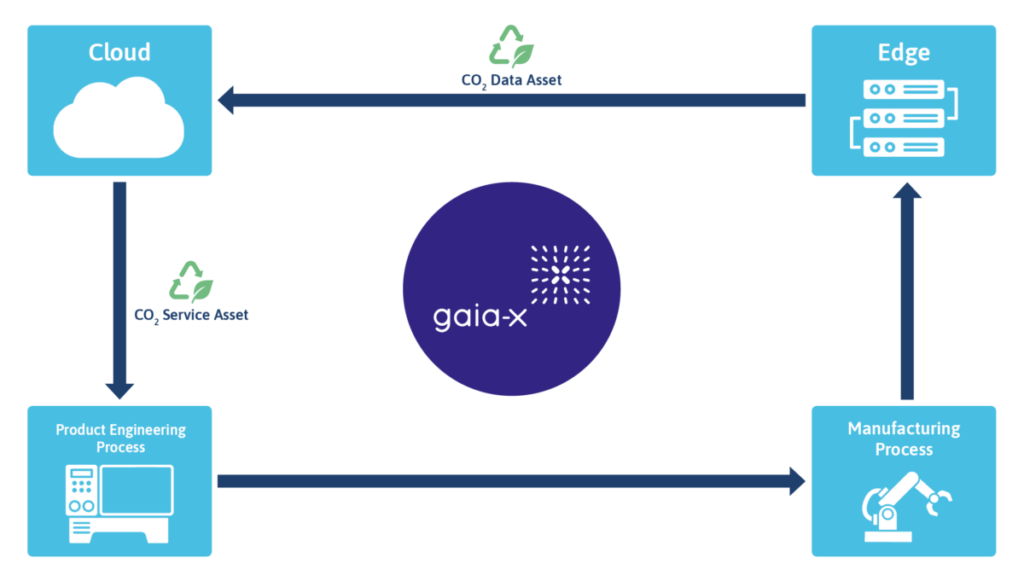
Verified carbon data at the design stage — before a single part is made.
Data spaces will do for industrial data what the internet did for information: companies that connect early shape the rules and capture first-mover advantage. Latecomers face a structurally less favourable position – higher onboarding costs, fewer negotiating options and a compliance backlog already threatening their customer relationships.
The CO₂ measurement challenge is not going away. Regulators, customers and investors are demanding verified emissions data with accelerating urgency. The only scalable, cost-effective way to meet this demand as a supply chain participant is through shared data infrastructure. The business model opportunity is equally real: SMEs that become trusted data providers within their ecosystem can monetise assets they already own, starting now.
The technology is ready. The regulatory pressure is here. The question is only whether a company leads – or follows.