



“One line, many possibilities”: Modular AI automation for cable manufacturing


12 March 2026
Share



Across European manufacturing, cable assembly remains one of the least automated segments of production. While cables and connectors are manufactured automatically, their integration — especially in complex cables containing multiple conductors, shielding layers and connectors — still relies heavily on manual labour.
Frisimos Technologies, together with Italian partner Klemi Contact, has developed a fully automated, modular cable-to-connector assembly line designed to address this structural gap. The collaboration began under the 2022 Transform call by EIT Manufacturing, which supported the development of the initial proof of concept. Following validation, EIT Manufacturing also invested in Frisimos Technologies to accelerate the transition from prototype to commercial product.
We built a modular line that replaces the manual bottleneck in complex cable assembly with robotics and AI-driven automation.
Tal Pechter, CEO and Founder of Frisimos Technologies
From partial automation to end-to-end integration
Most existing solutions automate only parts of the cable assembly process. Frisimos Technologies’ system integrates the entire workflow into one configurable line capable of handling complex cable architectures with multiple wires and layered shielding structures.
Its competitive advantage rests on four pillars: end-to-end integration within a single line, the ability to manage multi-wire cable complexity, miniature robotic units that handle each wire individually and a modular system architecture.
Modularity is critical for manufacturers operating in high-mix, low-volume environments: a common reality across Europe. Instead of replacing entire production lines when product requirements change, companies can add or adjust modules. The production system evolves alongside the business.
The production line is not fixed. It can grow and adapt as product needs change.
Claudio Clementi, CEO of Klemi Contact
Robotics and AI as enabling technologies
The line is fully robotic, allowing reprogramming and adaptation across cable families without rigid, single-product configurations. Different cable types can be processed on the same platform with limited reconfiguration.
Artificial intelligence operates primarily through advanced machine vision. AI-driven image recognition analyses cable positioning and structure in real time, enabling robots to make handling decisions similar to experienced human operators. AI tools are also used during software development to strengthen system robustness and speed up deployment cycles.
The result is a stable and repeatable production process capable of managing increasingly complex cable designs with consistent quality.
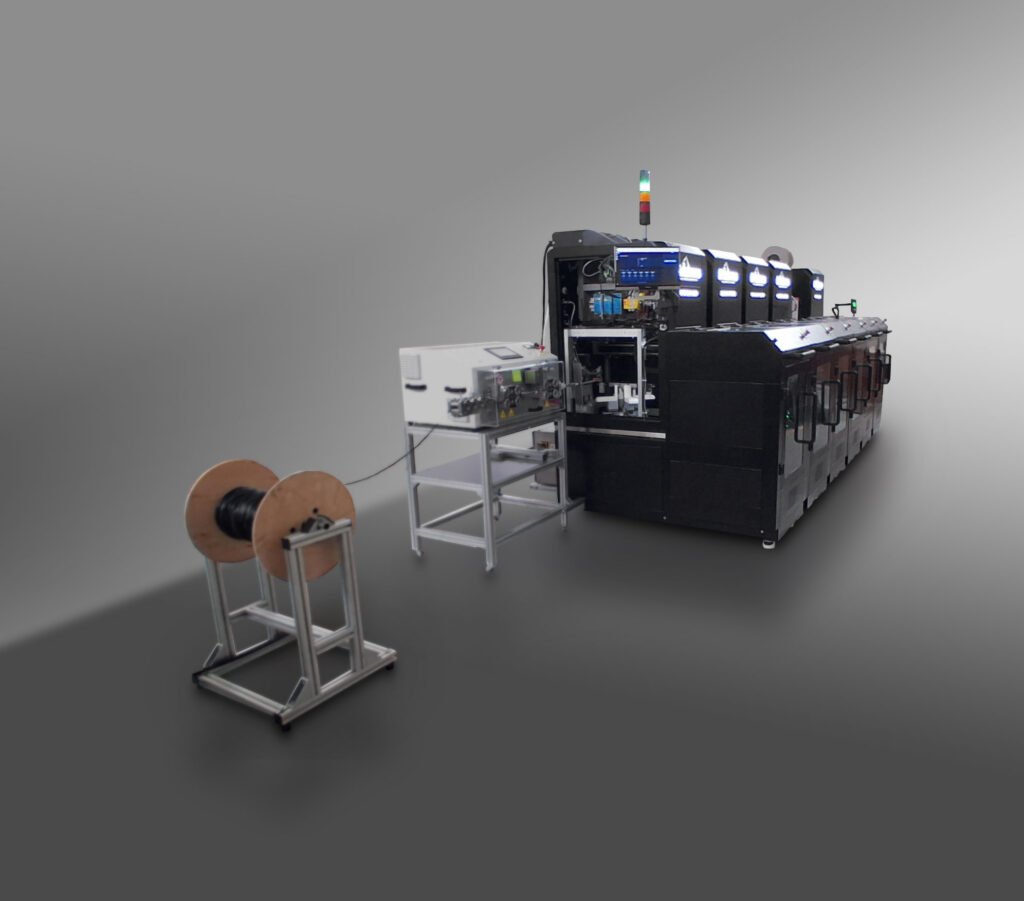
The modular AI-enabled cable-to-connector assembly line developed by Frisimos and Klemi Contact
Transforming the operator’s role
Automation in labour-intensive processes inevitably raises workforce questions. In this case, the shift is structural rather than eliminative.
“One operator can supervise what previously required dozens of manual assembly positions,” explains Tal Pechter, CEO and Founder of Frisimos Technologies. “The transition is from repetitive manual handling to advanced system supervision.”
Operators no longer assemble cables by hand but oversee robotic workflows, manage production parameters and monitor quality performance. Productivity per employee increases while the skill profile shifts toward technical supervision and process management.
For European manufacturers facing labour shortages and rising operational costs, this model supports higher-value employment and more resilient production structures.
From validation to market readiness
The initial proof of concept, supported by EIT Manufacturing’s SME Transform call, demonstrated that complex cable-to-connector automation could be modular, scalable and economically viable for small and mid-sized manufacturers. Following this validation, EIT Manufacturing’s investment enabled the partners to refine the system and prepare it for commercial rollout.
The system, commercially referred to as the M8/M12 automation line, is now entering the sales phase. An open house event happening in March 2026 in Milan will allow European connector manufacturers to see the system in operation and evaluate its integration potential.
“Seeing the system live makes the value proposition tangible,” Pechter says. “That is when industrial conversations become concrete.”
Strengthening European manufacturing capability
Beyond immediate productivity gains, the collaboration has strategic implications. The cable industry is increasingly shifting toward fibre optics, USB-C and high-data connector: segments where manual assembly still dominates.
Automating these processes locally enables manufacturers to maintain technological capability, reduce dependency on low-cost manual labour models and remain competitive in advanced cable production.
Because the platform is modular, new cable families can be integrated without replacing the full system. Shared production logic allows scalability as product portfolios evolve.
“The more complex the product, the stronger the benefit of automation.” comments Claudio Clementi, CEO and Founder of Klemi Contact.
One line, many possibilities
The Frisimos-Klemi collaboration illustrates how modular robotics and AI-based vision systems can address long-standing inefficiencies in cable assembly. By integrating flexibility, scalable architecture and real-time intelligence into a single platform, the system provides manufacturers with a pathway toward higher productivity, operational resilience and long-term competitiveness.
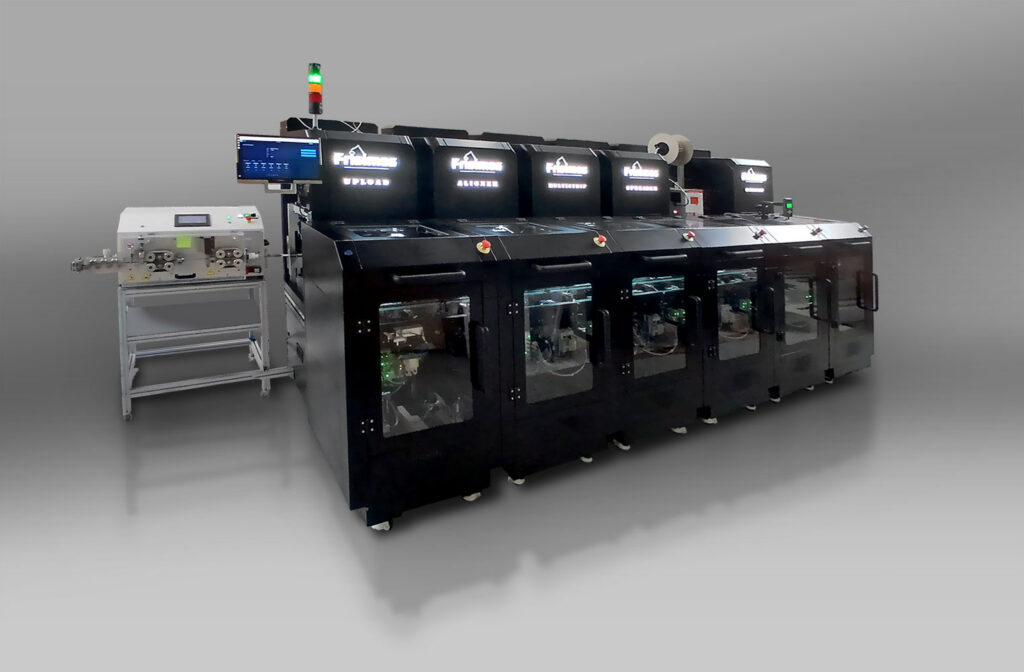
The modular cable-to-connector automation line, designed to adapt to different cable types and production needs.