



More than a moonshot: Meet startups bridging space and manufacturing


10 December 2025
Share




In 1962, John F. Kennedy stood at Rice University and made a pledge that defined modern history: “We choose to go to the moon”. Seven years later, Neil Armstrong was the first person ever to set foot on the moon. Behind this giant leap, manufacturing played an undeniably crucial yet rather unnoticed role.
The Apollo programme had a profound impact on the global manufacturing industry, including in Europe. The programme cost an estimated USD 25.8 billion, involved around 400,000 people and relied on more than 20,000 suppliers. Among them were prominent European players, such as ZEISS, Heraeus, Hasselblad, Thompson (now Thales France), Philips, Oerlikon and SKF.
History shows how space and manufacturing have always been interconnected, and innovation accelerates when these domains work together. This is precisely the foundation of the “space meets manufacturing” startup competition – a joint initiative of EIT Manufacturing, NL Space Campus and Space Business Innovation Centre (SBIC) Noordwijk.
Uniting space and manufacturing
The startup competition comes at a time when the space industry is becoming increasingly critical for Europe’s autonomy, sovereignty and competitiveness. The sector underpins critical infrastructure — from satellite communications and energy to climate monitoring — and is becoming integral to defence, as highlighted by national initiatives such as Germany’s recent Space Safety and Security Strategy.
The rising strategic importance contrasts with uneven dynamics. The Eurospace report shows the global launch mass hit 1,500 tons in 2023 — driven almost entirely by Starlink — while the US and China continued to dominate the spacecraft and launch markets, together holding 70% of both markets.
At the same time, the European aerospace, security and defence (A&D) ecosystem is a cornerstone of the continent’s technological leadership, generating EUR 290.4 billion in turnover in 2023, while the space sector alone reached EUR 8.5 billion in annual sales, doubling the figure from two decades ago. Employment in the sector also peaked at 62,500 jobs in 2023, strongly driven by a new wave of space startups.
Sustaining this momentum requires a shift in manufacturing strategies — anchored in deep tech and industrial scaling. Breakthroughs are especially needed in the fields of advanced photonics, in-orbit services (IOS) and additive manufacturing. From photonic integrated circuits to 3D-printed mission-critical components, and from autonomous robotic systems for space operations to resilient electronics that withstand extreme environments, these technologies are key to reducing dependency on external suppliers and reinforcing Europe’s technological sovereignty.
When we connect the mission-critical capabilities of space innovators with the engineering excellence of manufacturing, we create solutions that neither sector could achieve alone. By linking our ecosystems, we build a pipeline of technologies that strengthen Europe’s competitiveness in both space and manufacturing.
Silvia Grätz, Senior Manager Business Development and Innovation at EIT Manufacturing, emphasises the value of cross-sectoral collaboration
From factory floor to space
The principle behind the “space meets manufacturing” startup competition is simple but powerful: industry players present real challenges and startups propose innovative solutions. Whether it’s applying space technologies on the factory floor or adapting manufacturing processes for use in orbit, every solution creates cross-sectoral value.
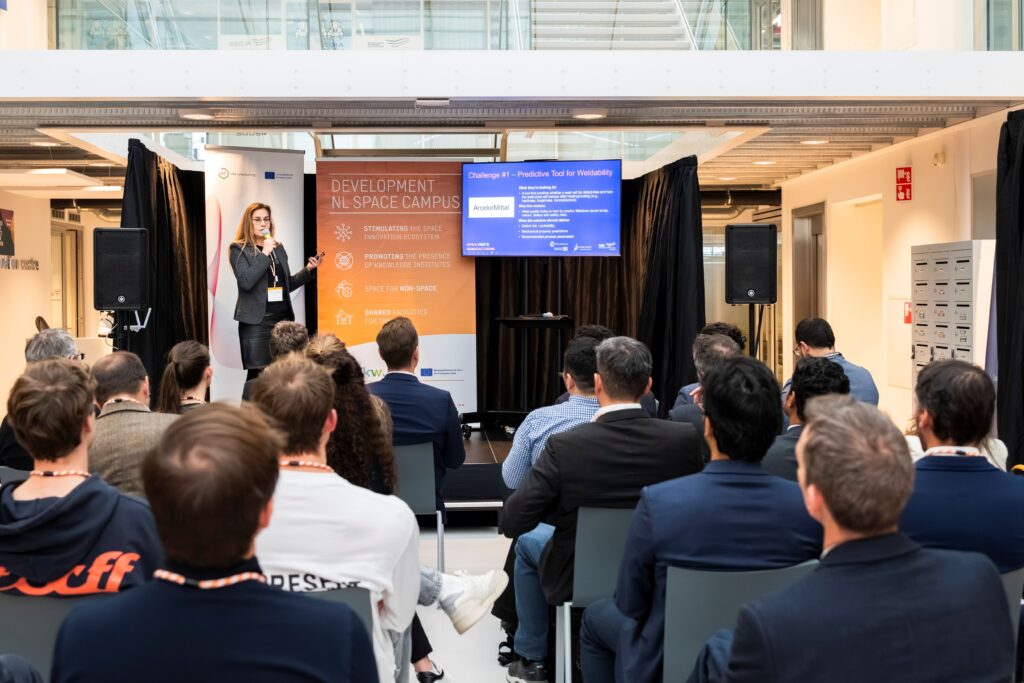
Real-world challenges presented by industry players: Özlem Güngör (ArcelorMittal) on stage
The 2025 edition featured five industry challenges from the European Space Agency (ESA), ArcelorMittal and Technoport in collaboration with the European Space Resources Innovation Centre (ESRIC). They addressed the need for a predictive tool for weldability, multi-purpose structural optimisation, non-destructive inspection methods, serial production technologies for hardware and space electronics, as well as bridging terrestrial technologies to space applications.
The challenges we face in manufacturing and space may look different, but the underlying technologies are often the same. This competition shows how much we can gain by breaking down these silos.
Olivier Zephir, Head of Business Development and Innovation at Technoport, summarised the cross-sector potential
Indeed, the strength of the initiative lies in its triple impact: it connects challenge owners with solution providers, sparks new partnerships and provides dedicated mentoring throughout the competition. Together, these elements give startups industry access and help companies explore cutting-edge solutions.
Through this competition, we are not only shining a spotlight on innovative startups – we are building bridges. Bridges between sectors, between technology and industry, between innovation and implementation.
Maaike Smelter, Community Manager at NL Space Campus
New industry solutions taking off
On 27 November, ten shortlisted startups presented their solution proposals to the jury at the competition finale in Noordwijk, the Netherlands. The finalists were ESOS Wind GmbH, IndustryApps, GeDy TrAss, RESONIKS, Warden Machinery, Novo AI, Sightwise, Tumi Robotics, Uncharted AI and SPAIDER SPACE.
The solution proposals spanned the full spectrum of industrial innovation: artificial intelligence (AI) platforms that power smarter factories, robotics capable of exploring harsh or confined environments, advanced sensors for monitoring materials and structures, synthetic-data tools that accelerate machine vision and mission-ready AI systems designed for space. Whether improving quality control on Earth or enabling autonomy in orbit, these teams demonstrated how breakthrough technologies can strengthen both manufacturing and space operations.
Choosing a winner was hard because there were many excellent technical solutions, each addressing a slightly different requirement aspect. However, all of them impressed with their degree of innovation, applicability and clear paths to rapid deployment in space and manufacturing processes.
Jury member Robert Ermisch, Business Development and Innovation Manager at EIT Manufacturing
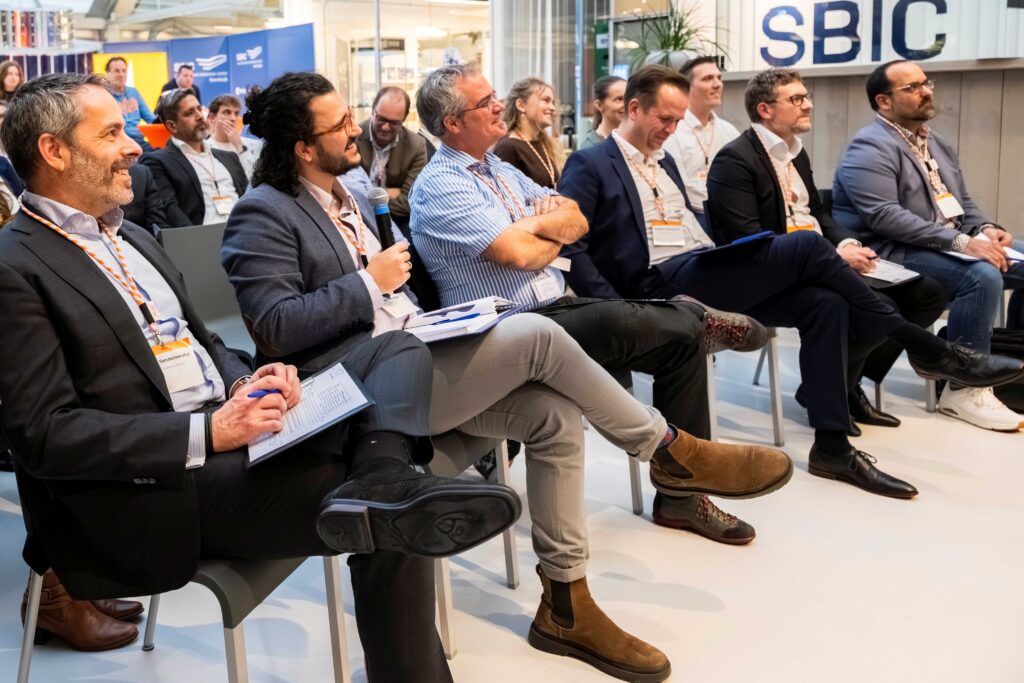
The jury of the space meets manufacturing competition: Marc Sandelkowsky (NL Space Campus), Jacobo Domingo Gil (SBIC), Andreas Tesch (ESA), Robert Ermisch (EIT Manufacturing), Lari Cujko (ESRIC) and Arnau Castillo Gonzalez (Collins Aerospace)
And the winners are…
Congratulations to Uncharted AI and Sightwise GmbH — the two winners bridging space and manufacturing!
Uncharted AI won the manufacturing track for its AI-powered autonomous robotic systems for exploration and mapping in extreme, GPS-denied environments. Their technology unlocks new functionalities for industrial sites and creates opportunities for future space missions. To expand their reach and internationalisation goals, the team received the EIT Manufacturing support package, including enhanced visibility across the community of over 200 partners and participation in key manufacturing events.
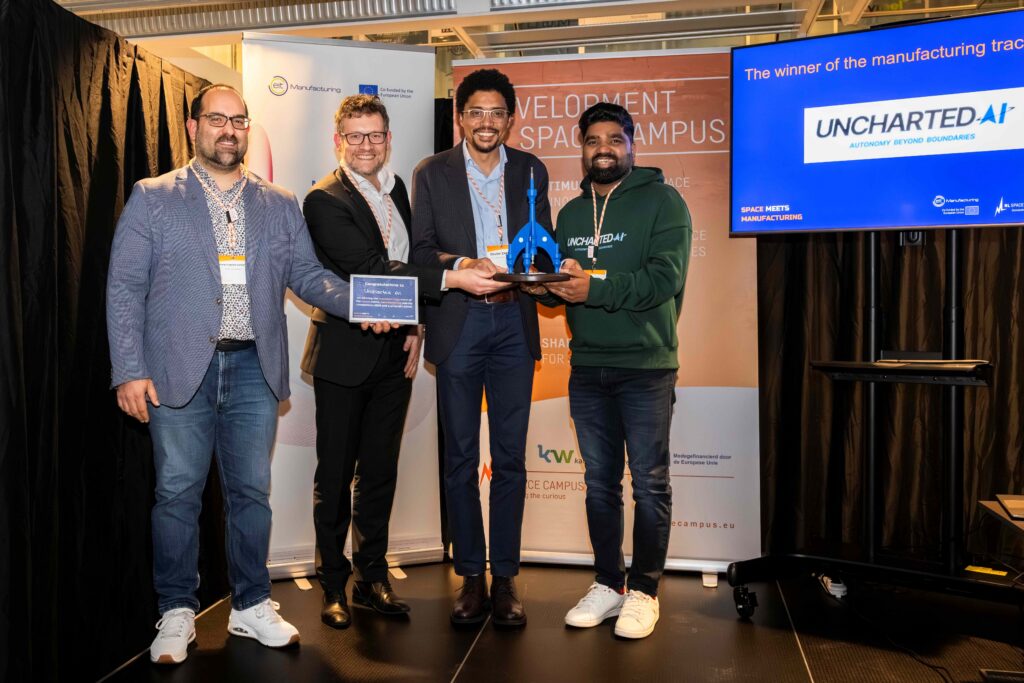
Arnau Castillo Gonzalez (Collins Aerospace), Lari Cujko (ESRIC) and Olivier Zephir (Technoport) together with the winner of the manufacturing track: Pradyumna Vyshnav (Uncharted AI)
The winner of the space track was Sightwise GmbH for its synthetic-data-driven machine vision solutions that enhance inspection quality and accelerate AI training. Their technology reduces risk, improves reliability and supports advanced automation both on Earth and in orbit. The team will receive business development support from SBIC Noordwijk and NL Space Campus, access to the SBIC partner network and space events, as well as visibility in international space media.

Robert Ermisch (EIT Manufacturing), Jacobo Domingo (SBIC) and Andreas Tesch (ESA) with the winner of the space track: Nils Gutsche (Sightwise)
In addition, industry partners are already exploring potential proof-of-concept collaborations and further applications of the technologies with the finalists.
Looking ahead
The startup competition “space meets manufacturing” demonstrates what becomes possible when Europe’s ecosystems collaborate. By supporting startups, connecting networks and providing platforms for cross-sector innovation, the initiative strengthens Europe’s strategic position at the intersection of advanced manufacturing and space technology.