







29 January 2026
Share



End-of-line inspection is pretty much standard in quality control of metal parts. RESONIKS, a young company offering acoustic quality control, suggests that inspection earlier on may be an even better option – without additional staff and with the potential to minimise waste, electricity consumption and thus CO2 emissions.
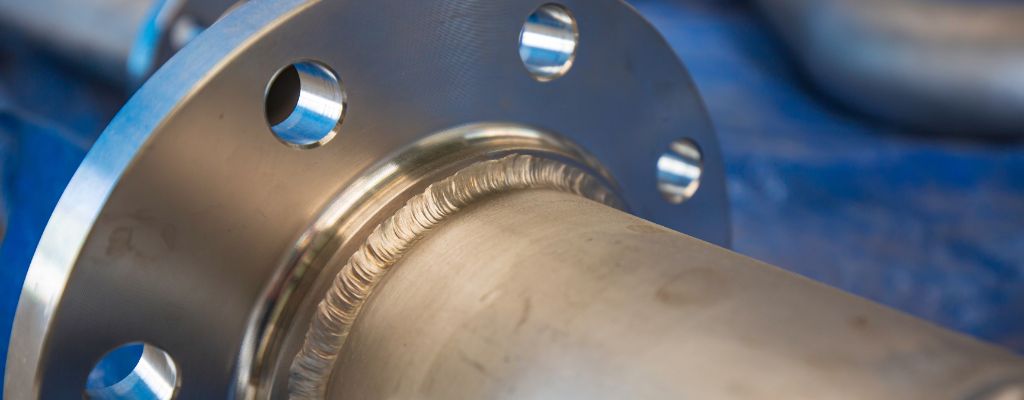
Metal parts can be tested via their acoustic fingerprint.
“From conversations about quality control we realised that quality control has made it to the management agenda. Specifically, inspection processes and technologies used traditionally have come under scrutiny from managers”, says Felix Wassmann, CEO of RESONIKS. “We found this interesting, because people gave us different reasons why the status quo is being questioned.”
Lack of skilled staff was one of them. If inspection requires certain qualifications, managers were reticent to maintain or build a respective stand at the end of the line. Their experience with fluctuation in manufacturing made them doubt there would always be staff with the right training to operate it.
Cost and time pressure was a factor for others, who dispatched parts to external labs, sought ways to insource sample inspection. They wanted to avoid the cost and the delay that the testing incurred – and find solutions for the question what to do with the batch if some tested samples were found to be defective.
Yet others wanted to automate inspection, thus making processes reproducible and independent of experienced or properly trained staff. Sometimes their current testing methods also did not yield the appropriate results, were too slow or too costly.
All of these pain points find their solution in a new inspection method – and the option to test parts along the production process.
Our acoustic inspection can even test incoming goods and thus prevent defective parts from being further refined but discarded as a result of the end-of-line inspection. The system can be used anywhere in or near the line – whether it’s only samples or 100% inspection that our customers require.
Felix Wassmann, CEO of RESONIKS
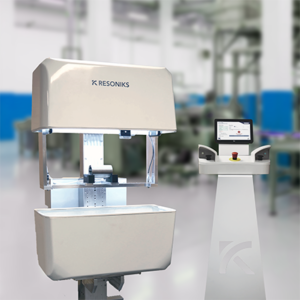 RESONIKS’ inspection system captures acoustic fingerprints of objects. It taps an object with a precision hammer, records its acoustic response through specialised microphones and uses artificial intelligence to analyse the resonance pattern. The AI compares the pattern to the one established during the training and validation phase, in which the system is trained with samples and validated with defective parts. Any deviation from the learned fingerprint of a good part indicates a structural defect. “The result arrives in seconds,” says Felix Wassmann.
The picture shows the RESONIKS’ QC600 system, which can be used at any point in or near the production line.
Founded in 2022 as a startup, RESONIKS gained traction fast, and operates from the Netherlands, Finland and Germany today. They received seed funding for their concept and prototype, which was still built from off-the-shelf components. In the meantime, the RESONIKS team has designed their own system and refined its characteristics, e.g., with microphones dedicated to being read by AI sensors.
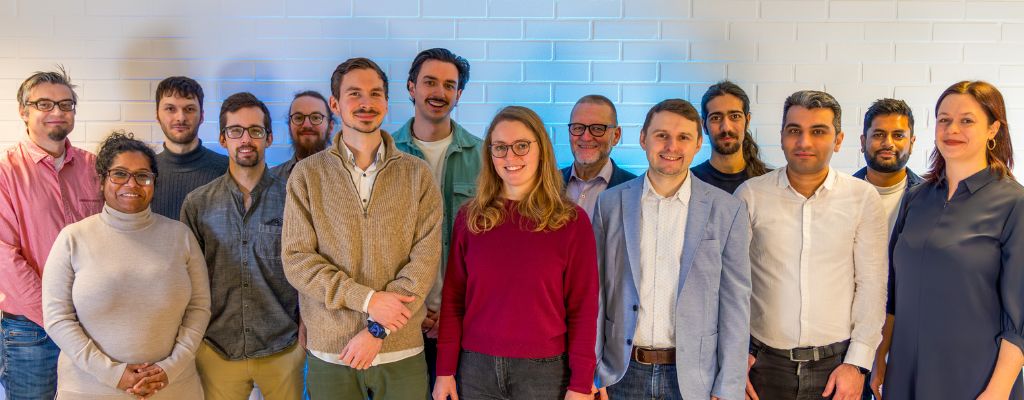
The RESONIKS team in 2026
The young company has piloted their technology in several factories, validating commercial pilots and deploying early systems. The main field of application has been metal parts, both forged or cast, in the automotive and aviation industries, original equipment manufacturers as well as tier 1, with a recent proof of concept also for ceramics. “In some cases, our customers actually used the principle of tapping their parts with a hammer already – but human ears needed to recognise the defect,” Felix Wassmann remarks, “we were able to automate this process and make it reproducible as well as scalable.”
Throughout 2024 and 2025, RESONIKS sought conversations with manufacturing stakeholder on industry events across Europe. Not only, but also supported by EIT Manufacturing for additional visibility, they presented their technology, joined panel or stage sessions and benefited from shared booth opportunities, e.g., at Hannover Fair in 2025.
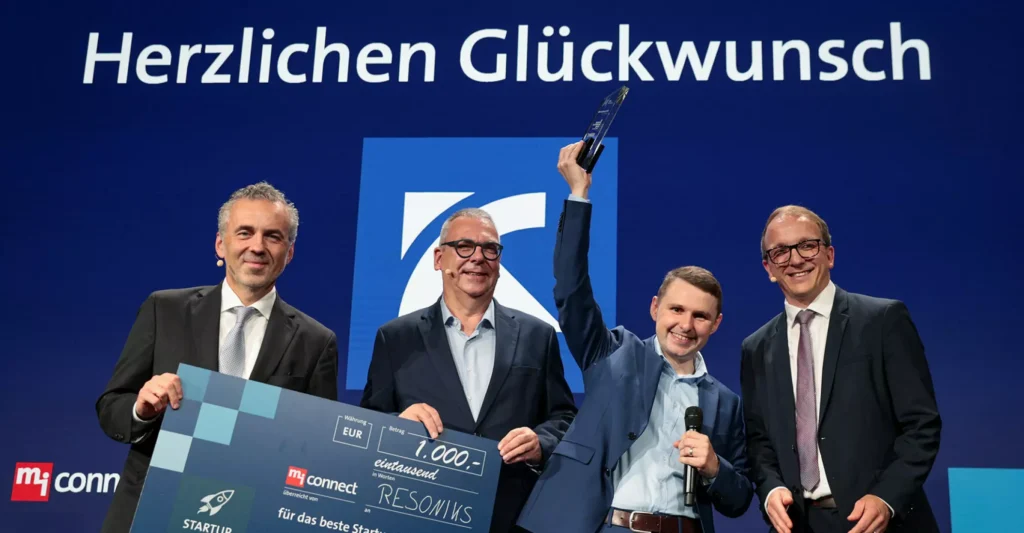
CTO Fabian Oberndorfer won the VDMA startup award for RESONIKS at Deutscher Maschinenbaugipfel 2025.
The attention for the technology has been considerable, earning RESONIKS the VDMA Startup Award 2025 as well as the HelloTomorrow Industry & Machines Award.
We pitched in front of 600 decision makers at Deutscher Maschinenbaugipfel. After a five-minute pitch, we received several leads from German industry leaders. We are now in the process of finalising several systems for delivery.
Felix Wassmann, CEO of RESONIKS
In the beginning of their journey, RESONIKS focused on end-of-line inspections. With experience and more interaction with interested experts and customers, it became clear that inspection earlier in the line would often be more beneficial for their customers. Since their system can be operated at any stage of the line, they now talk about the best place to integrate it with their customers.
“The flexibility brought out another facet: In addition to lack of qualified staff and the need to automate, sustainability concerns have entered the conversations,” observes Felix Wassmann. “Our system can certainly contribute to minimising CO2 emissions if it’s used early in the process, even though we cannot support this claim with data yet. But it’s logical – the earlier in the process we can sort out a defective part, the less unnecessary energy is used.”
RESONIKS provides AI-powered acoustic testing that detects hidden structural defects in manufactured components. As data volumes from acoustic signals are smaller than from visual data, results are shown within seconds. Their system enables fast, safe and fully automated quality control across industrial production – anywhere in or next to the production line.
Industrial manufacturers need fast, reliable methods to detect subsurface defects. RESONIKS enables affordable, automated 100% inspection to reduce scrap, ensure product safety and avoid recalls.
Acoustic testing can replace testing methods like computer tomography, X-ray, dye penetrant or ultrasonics and verify structural integrity with one test method. For most other methods, 100% testing is neither feasible nor affordable.
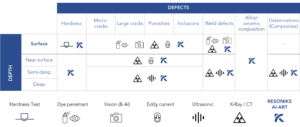
Overview of test methods that acoustic testing can replace.
After its foundation in 2022, RESONIKS has grown to 17 people in 2025. Their founder team, Felix Wassmann and Fabian Oberndorfer have led their team with a broad knowledge base of finance, sales, marketing, HR (Felix) and technology and engineering, vibration management and acoustic intuition (Fabian). While their technology can be applied to a broad range of materials, they have focused on metal to hone the system and put figures to the benefits: Acoustic testing can be 10-100x faster than computer tomography scans and up to 71% less expensive. Investors, including EIT Manufacturing, and big industry players have put money and trust in the company.
RESONIKS perceives a shift toward real-time, automated structural integrity testing, integrated directly into production lines and eventually into machinery, robotics and infrastructure monitoring. Their system is an ideal candidate to answer all requirements for these challenges.
They aim to take Japan in 2026 via the “Plug & Play Japan“ innovation platform and aim to enter the North American market in 2028 as they scale production and obtain the necessary certifications.