




Silvia Grätz
Senior Manager, Business Development & Innovation, Central Region



19 February 2026
Share




The civilisation we live in today depends on critical minerals. So does manufacturing. Recycling and circular design is one approach to dealing with the growing demand and limited availability of those materials. Turning our eyes away from the earth and towards space — however averse environmental conditions may be there for human life — is another approach.
The founders of Uncharted AI have exactly this environment in mind when they design their autonomous robotic systems. When they speak about their systems, they point out their ‘embodied intelligence’.
Robots are, at their core, physical extensions of human capability — mechanical embodiments of our limbs, mobility, vision and hearing. At Uncharted AI, we layer this physical form with a sophisticated intelligence stack that mirrors human perception, reasoning and decision-making. The result: autonomous systems capable of operating independently in environments too dangerous, remote or uninhabitable for people — from deep mines and disaster zones to planetary surfaces beyond Earth.
Pradyumna Vyshnav, Co-Founder & CEO of Uncharted AI
Their systems autonomously explore and reason in remote, high-risk environments in which GPS is not available and where involving human labour is potentially dangerous, slow and expensive. Currently, they are mainly used to discover, map and monitor critical mineral resources on Earth, but the Uncharted AI team is aiming for the moon and beyond.


The outlook for their line of business is promising. According to Pradyumna Vyshnav, mining remains one of the least digitised trillion-euro industries, with mineral exploration success rates below one per cent.
At the same time, the sector faces growing pressure. An increase of clean and renewable energy production has contributed to a rising demand for critical resources used in batteries, wind turbines and solar panels. In addition to this, inhumane labour conditions in mines and the environmental impact of the extraction of critical minerals cannot be ignored.
Our systems reduce exploration costs by up to 75%, cut timelines by 50% and enable safer, lower-impact surveys — contributing directly to labourers’ safety, automation, digitalisation and sustainable resource development. Within the next five years, mining will be transformed from manual, drill-heavy exploration to AI-driven, minimally invasive, autonomous operations.
Dr Vivek Varadharajan, Co-Founder & CTO of Uncharted AI
The robotic systems Uncharted AI has developed are equipped with RGB-D and hyperspectral cameras as well as Light Detection and Ranging (LiDAR) and ground-penetrating radar (GPR) sensors. Additionally, the systems have an inertial measurement unit. Their proprietary artificial intelligence algorithms fuse the data from multiple sensor modalities, generating high-fidelity, 3D digital twins of surface and subsurface regions in real-time.
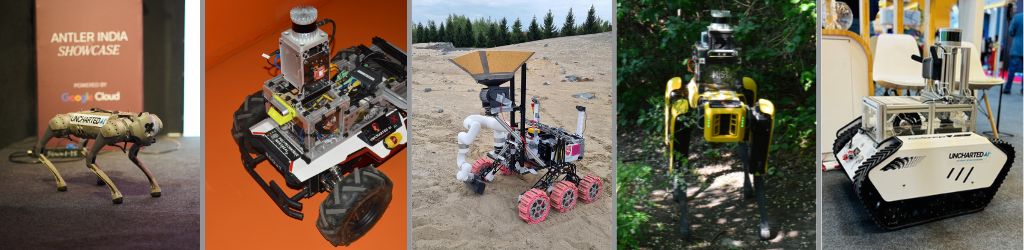
Autonomous robotic systems come in a variety of shapes.
The founders of Uncharted AI took inspiration from the autonomy that Mars rovers had on their missions — they are convinced that terrestrial missions require the same form of autonomy. Mining operators in Australia, Middle East and India value the autonomy that Uncharted AI designs into their systems. They are currently validating the full-stack exploration systems in field pilots.
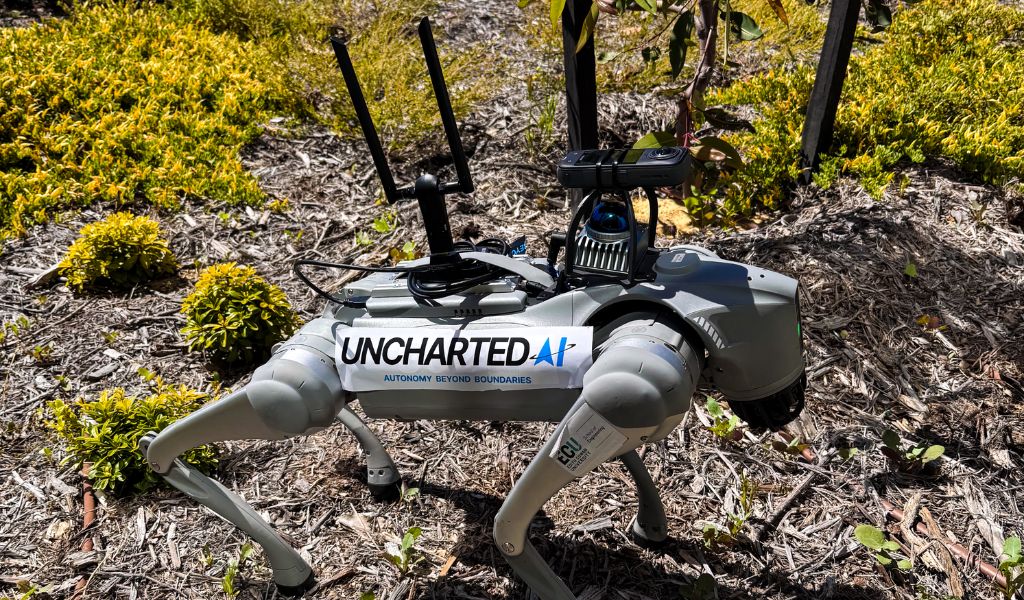
One of Uncharted AI’s autonomous robotic systems in the field.
Their solution has won international recognition precisely for mining — Uncharted AI recently won first place of the Future Minerals Pioneers programme in Riyadh, Saudi Arabia. In the Smart Technologies for Mining Operations and Services track, they won as the only team with embodied intelligence among 70 global finalists.
Space robotics can fundamentally reshape how we discover and manage Earth’s resources—driving efficiency, sustainability and innovation in manufacturing. We see it as a strategic dual-use technology with profound impact across industries and space.
Dr Vivek Varadharajan, Co-Founder & CTO of Uncharted AI
Having established first contact with the European Space Agency already, the opportunity for broader access to the European space and manufacturing ecosystem motivated Uncharted AI to take part in the space meets manufacturing competition, a startup competition, which was jointly organised by NL Space Campus, Space Business Innovation Centre (SBIC) Noordwijk and EIT Manufacturing and sponsored by Technoport and European Space Resources Innovation Centre (ESRIC).
Uncharted AI pitched their robotics systems as a means for reliably prospecting space resources, a challenge which had been described by Technoport and ESRIC. The jury recognised the potential of transferring space-grade autonomy into terrestrial industrial applications and selected the company as one of the two winners of the competition.
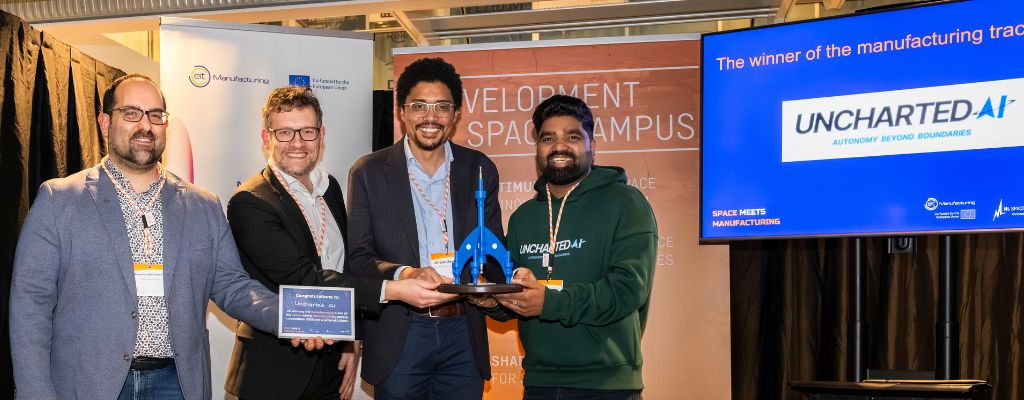
Uncharted AI on stage at NL Space Campus in November 2025.
Through the space meets manufacturing competition, we gained strategic validation, European ecosystem access and exposure to advanced manufacturing stakeholders. The most valuable outcome was the recognition from those stakeholders that space-derived autonomy is not futuristic—it is commercially viable today.
Pradyumna Vyshnav, Co-Founder & CEO of Uncharted
‘Space meets manufacturing‘ brings together actors from the space and manufacturing sectors to explore cross-sector applications of advanced technologies. By connecting technology providers with industrial stakeholders, the programme aims to accelerate the translation of space-derived innovations into practical manufacturing use cases.
The initiative will be continued in 2026.
Uncharted AI builds autonomous robotic systems powered by domain-specific AI to discover, map and monitor critical mineral resources — on Earth today and in space tomorrow.
The founding team, Pradyumna Vyshnav (Co-Founder & CEO) and Dr Vivek Varadharajan (Co-Founder & CTO), have worked on advanced robotic missions at NASA Jet Propulsion Laboratory (JPL), Defense Advanced Research Projects Agency (DARPA), Canadian Space Agency and across deep-tech startups like FieldAI in AI and field robotics. Their team combines robotics engineers, AI researchers, geoscientists and systems engineers, reflecting diversity across disciplines and international backgrounds spanning space, mining and manufacturing ecosystems.
Their autonomous robotic platforms create detailed 3D digital twins of surface and subsurface structures, enabling access to remote, GPS-denied and hazardous environments where traditional human-led operations are unsafe, inefficient and expensive.
The robotic system is an integrated solution for mapping as well as prospecting and monitoring of the targeted terrain. It can be applied in terrestrial as well as lunar missions and could support future in-situ resource utilisation (ISRU) on the moon.
Benefits include:
• up to 75% lower exploration costs
• 80% less exposure of field personnel
• Significantly less invasive drilling
• Real-time analytics enable faster decision making
• Electric robotic systems reduce carbon footprint
Uncharted AI seeks to become the global autonomy layer for resource discovery — on Earth and beyond. They aim to redefine how humanity explores, ensuring that resource discovery aligns with sustainability, safety and planetary stewardship. Uncharted AI is expanding their team in robotics, AI and planetary autonomy while focusing on strategic mining pilots, OEM integrations, geographic expansion and cross-sector transfer into defence as well as space resource markets.